Platform Products Aurora™ askAurora™ Aurora:GeoStudio® Capabilities Use Cases Governance C3.ai Request Access

Use Case · Critical National Infrastructure

Anticipatory infrastructure protection.

Risk to national infrastructure rarely arrives as a single, attributable event. Aurora™, powered by C3.ai, widens the defensive aperture — fusing local sensing with wider mobility context to surface the weak signals of hostile preparation before they cross the alarm threshold.

Sector: Critical National Infrastructure Joint architecture: Aurora™ + C3.ai Classification: Unclassified / Conceptual
The Challenge

The threat lives below the alarm threshold.

Hostile reconnaissance, coercive signalling, cyber-physical probing, and insider facilitation develop subtly around an asset — in the space that isolated technical monitoring and site-boundary security simply cannot see. The consequence is either overreaction to isolated signals or delayed recognition of genuinely significant activity. Traditional defenses only trigger once the threat has already escalated into an incident.
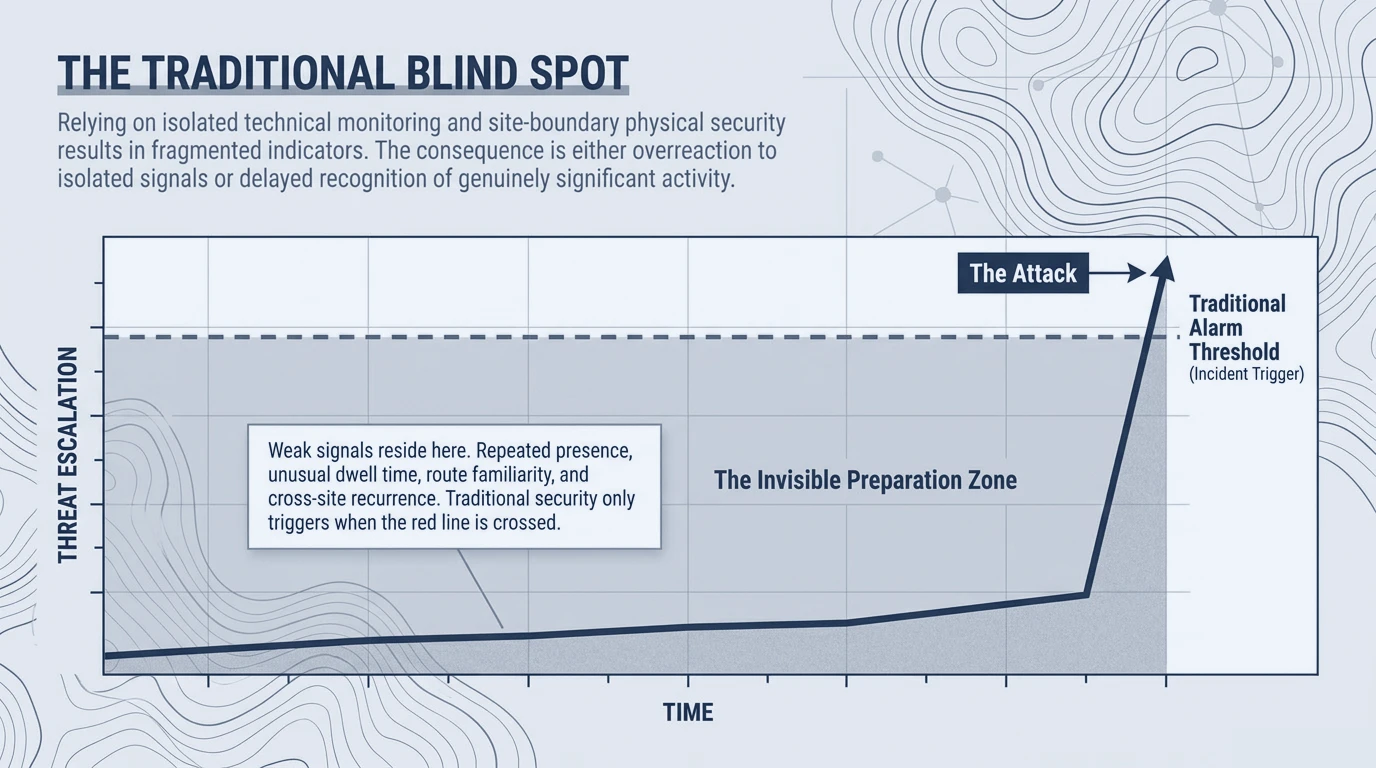
Threat-escalation chart: weak signals accumulate in an invisible preparation zone below the traditional alarm threshold before spiking sharply at the point of attack.
The invisible preparation zone. Repeated presence, unusual dwell time, route familiarity, and cross-site recurrence accumulate below the alarm threshold — traditional security only triggers once the line is crossed.
The Approach

Widening the aperture with a contextual ring.

Aurora widens the defensive aperture beyond the fence line through a layered, data-driven contextual ring: the asset at the center, passive site-adjacent situational awareness around it, and a regional mobility-context layer derived from anonymized movement baselines — revealing route progression, repeated visits, and cross-site linkage that no perimeter sensor can see.
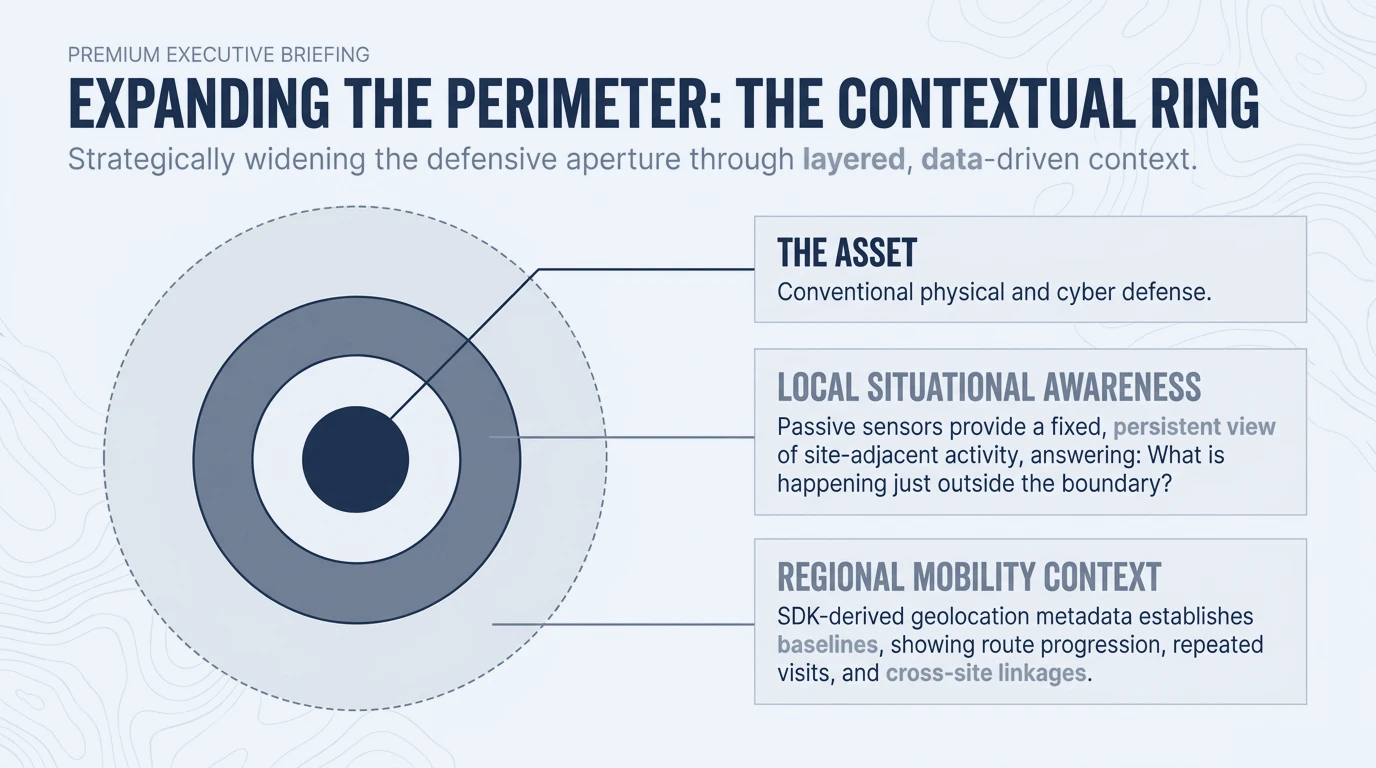
Concentric-ring diagram: the asset at center, local situational awareness around it, and an outer regional mobility-context layer.
Expanding the perimeter. The asset, a ring of local situational awareness, and an outer regional mobility-context layer combine to extend defensive vision beyond the boundary.

The data foundation: local sensing + mobility context.

Two inputs combine into a single anticipatory capability. Persistent local sensors generate localized awareness of presence, recurrence, density, and dwell near vulnerable access areas. Global geolocation metadata provides wider movement context across geography and time. Together they yield meaningful intelligence that differentiates ordinary background movement from potentially hostile reconnaissance.
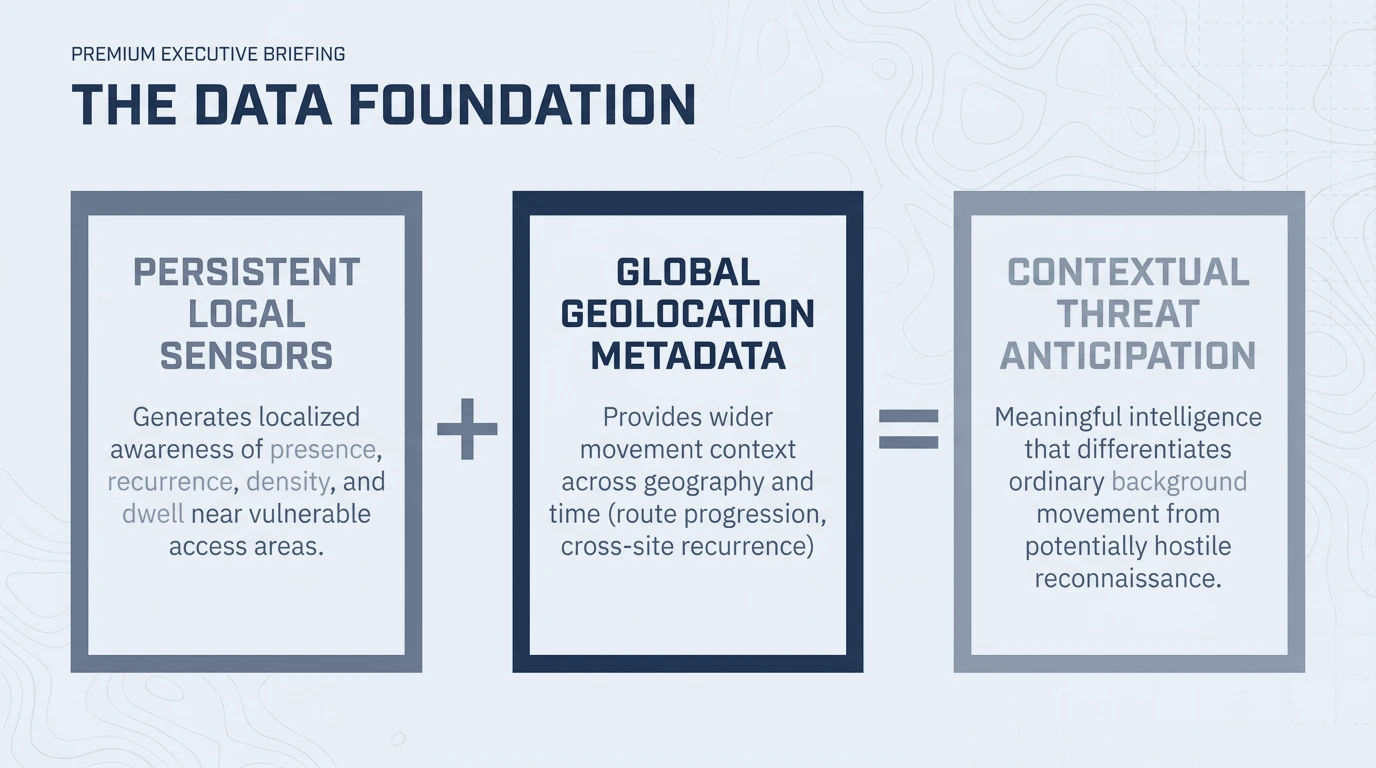
An equation graphic: persistent local sensors plus global geolocation metadata equals contextual threat anticipation.
Local + wider context = anticipation. Persistent local sensing combined with wider mobility context separates routine movement from genuine reconnaissance.
The Outcome

Enterprise scale, on the C3.ai backbone.

The capability runs on an institutional-scale enterprise backbone — federated integration across siloed departments, geo-temporal modeling, and a secure runtime. A local irregularity at one site is re-interpreted as coordinated, multi-site interest in connected national infrastructure, with weak signals connected into high-confidence, lawful, validated early warning.
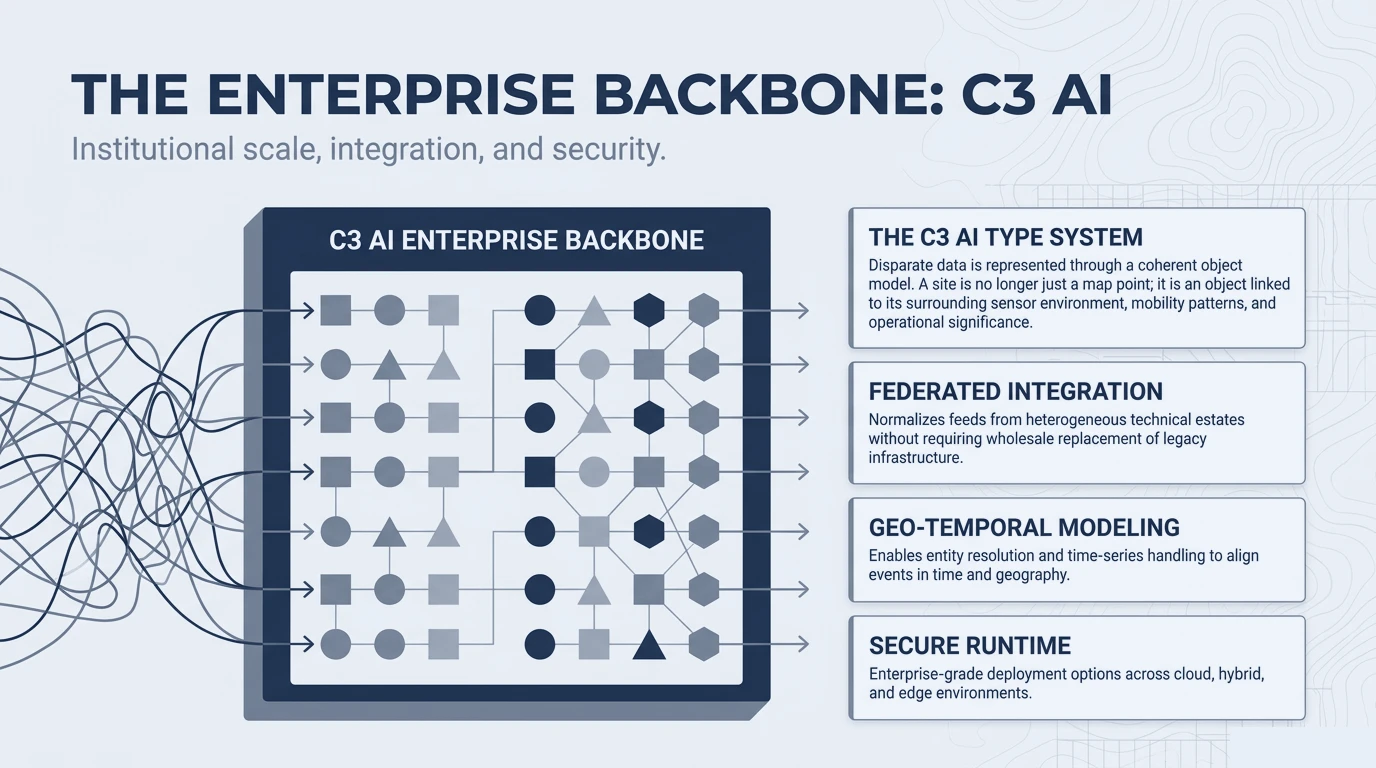
The C3.ai enterprise backbone diagram showing a type system, federated integration, geo-temporal modeling and secure runtime.
The enterprise backbone. Federated integration, geo-temporal modeling, and a secure runtime give the capability institutional scale and integration.
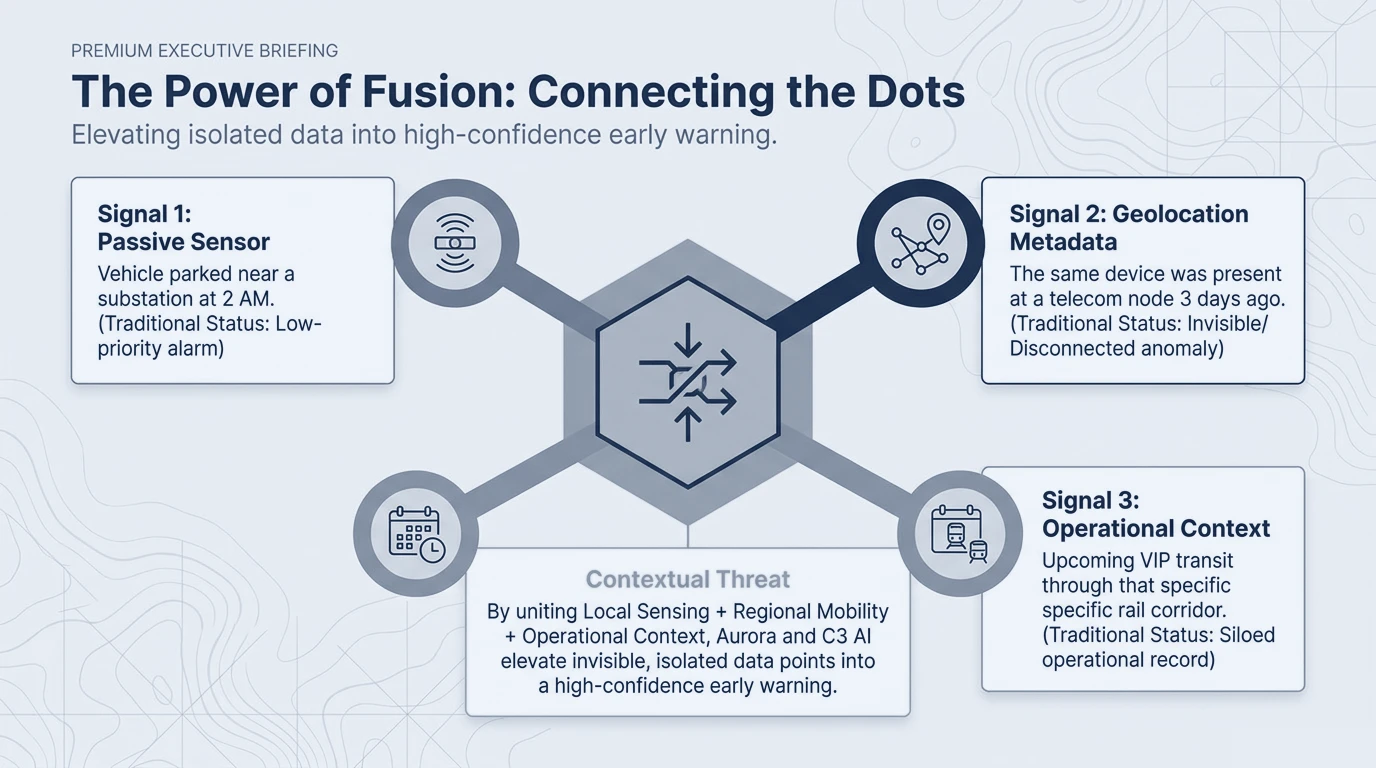
Three signals — passive sensor, geolocation metadata, and operational context — converging into a single high-confidence contextual threat indicator.
Connecting the dots. A passive sensor alert, geolocation metadata, and operational context fuse into one high-confidence indicator — earlier warning from signals that are individually inconclusive.
Earlier
Warning before the alarm threshold is crossed
Multi-site
Cross-site recurrence linked into one picture
Lawful
Validated, governed decision support
Note on sourcing. This case study presents a joint reference architecture (Aurora™ + C3.ai). It is conceptual and contains no customer-specific operational detail; figures are illustrative of the analytical method.

See the threat forming, not just the incident.

Aurora™, powered by C3.ai, is available to authorized operators and protectors of critical national infrastructure. Access begins with a defined mission problem.