Platform Products Aurora™ askAurora™ Aurora:GeoStudio® Capabilities Use Cases Governance C3.ai Request Access

Use Case · Counterintelligence & OPSEC

Protecting a sensitive facility from telemetry exposure.

Dense mobile telemetry quietly exposes a sensitive site's operational cadence — and which devices are persistently present. Aurora™ filtered the noise to a short list of resident devices and surfaced foreign telemetry anomalies indicating location spoofing.

Sector: National Security & Sensitive R&D Capability: Mobility & Telemetry Analysis Classification: Unclassified / Illustrative
The Challenge

Commercial telemetry is an OPSEC exposure.

Commercially-available mobility data maps the rhythm of a sensitive site without ever crossing the fence line: who is persistently present, when activity peaks, and where staff and contractors come and go. In the wrong hands, that pattern is a counterintelligence and operational-security risk — site cadence reconstructed entirely from devices, no physical surveillance required.

The Approach

From noise to a prioritized shortlist.

Aurora applied a signal-to-noise funnel to the full body of location records across thousands of anonymized devices. Transient and low-recurrence traffic — drive-by, event, and delivery patterns — was filtered out tier by tier, isolating a small set of highly persistent, resident devices as the immediate priority for counterintelligence and operational-security screening.
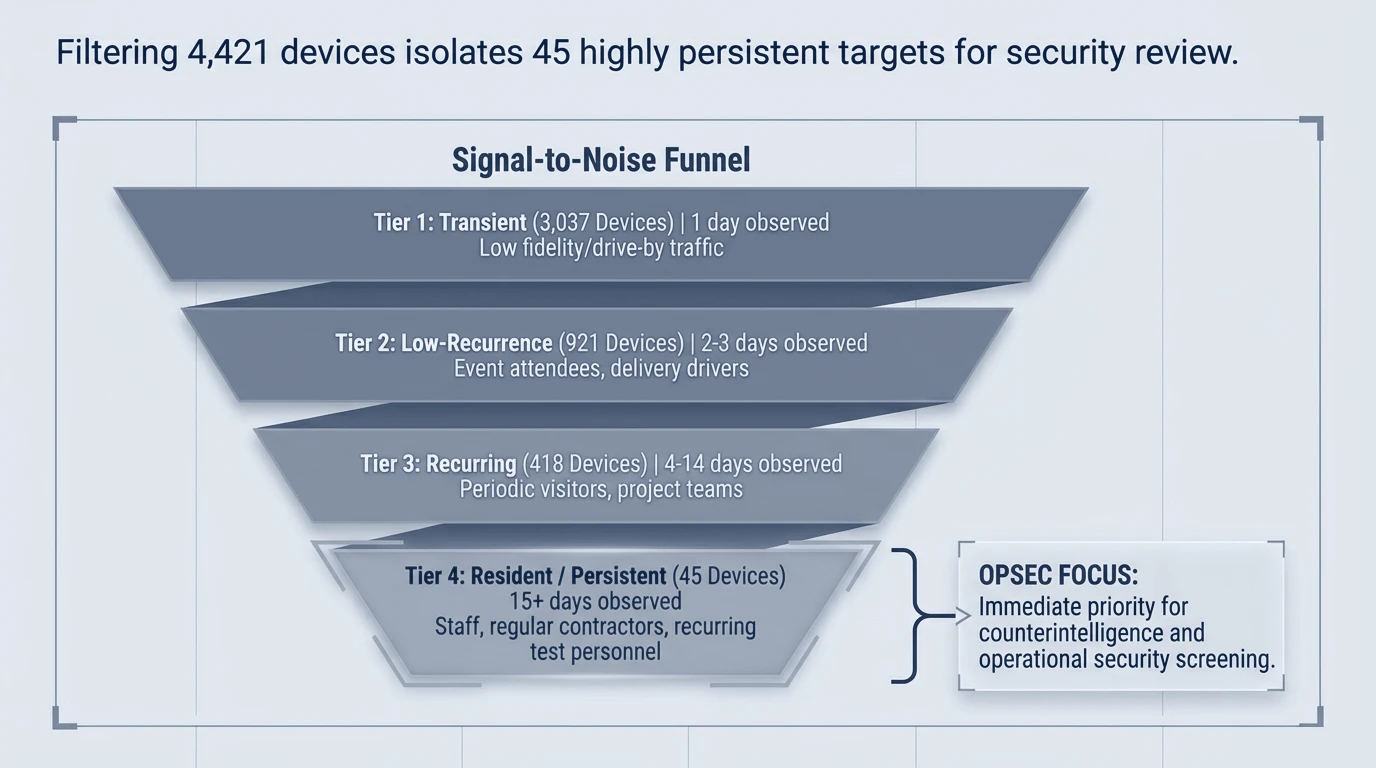
A four-tier signal-to-noise funnel filtering thousands of devices down to 45 highly persistent resident devices flagged for OPSEC review.
The signal-to-noise funnel. Thousands of devices reduce, tier by tier, to a small resident cohort — staff, regular contractors, and recurring personnel — flagged as the immediate OPSEC priority.

Separating real movement from spoofing.

Within the resident cohort, Aurora diagnosed a foreign-telemetry vector: devices that never physically left the site, yet whose data was routed through foreign servers via a compromised app, VPN, or commercial SDK — registering as a physical "ping" abroad. Distinguishing genuine physical movement from network artifacts is what separates a real anomaly from a false one.
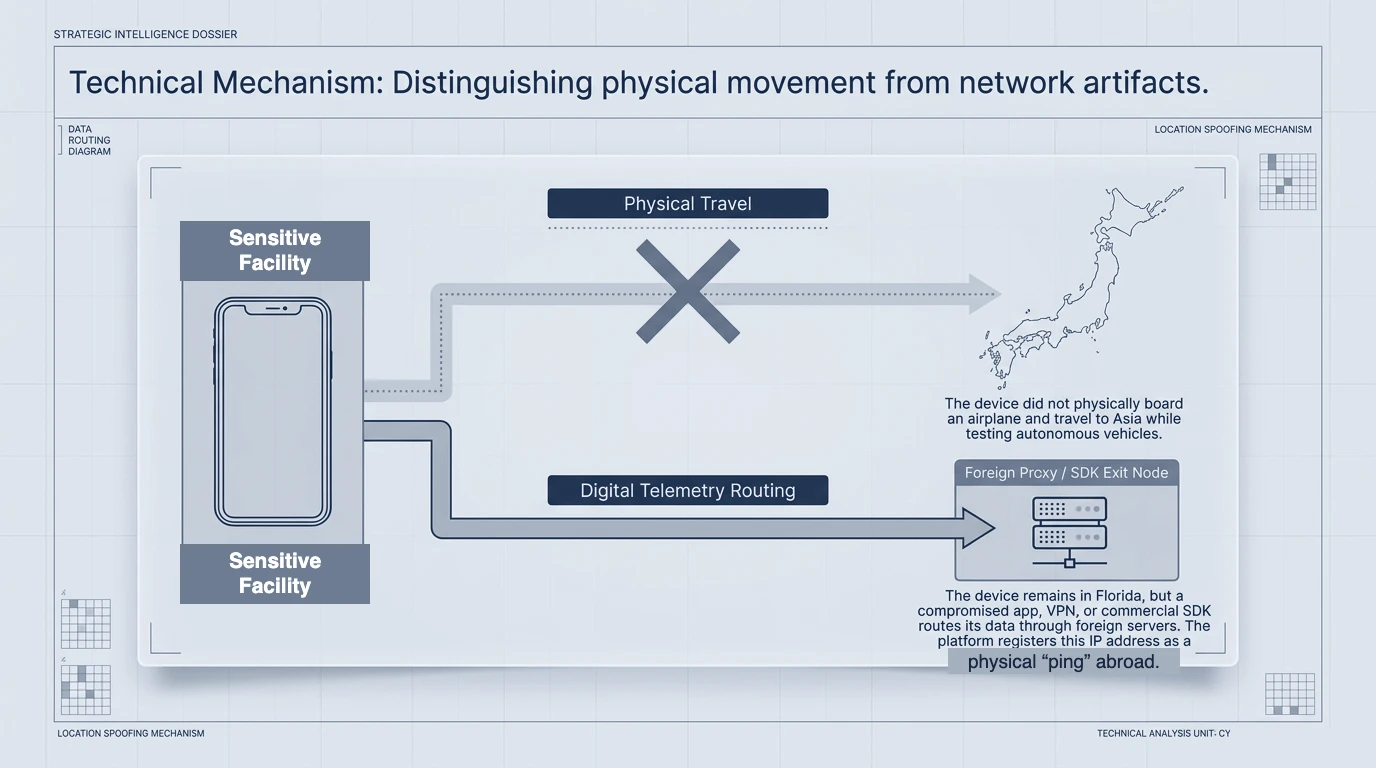
A location-spoofing diagram: a device that remains on-site has its digital telemetry routed through a foreign proxy / SDK exit node, registering as a physical ping abroad.
Physical travel vs. digital routing. The device never moves, but a compromised app, VPN, or SDK routes its data through a foreign exit node — the platform registers a physical "ping" abroad.
The Outcome

A complete, non-attributive threat model.

The result is a prioritized, non-attributive shortlist for technical validation — with anomaly windows correlated against physical access patterns. The threat isn't foreign agents at the fence; it's domestic, trusted devices carrying aggressive ad-tech, foreign SDKs, or compromised apps into a sensitive zone, and bleeding location and network data to foreign infrastructure in real time.
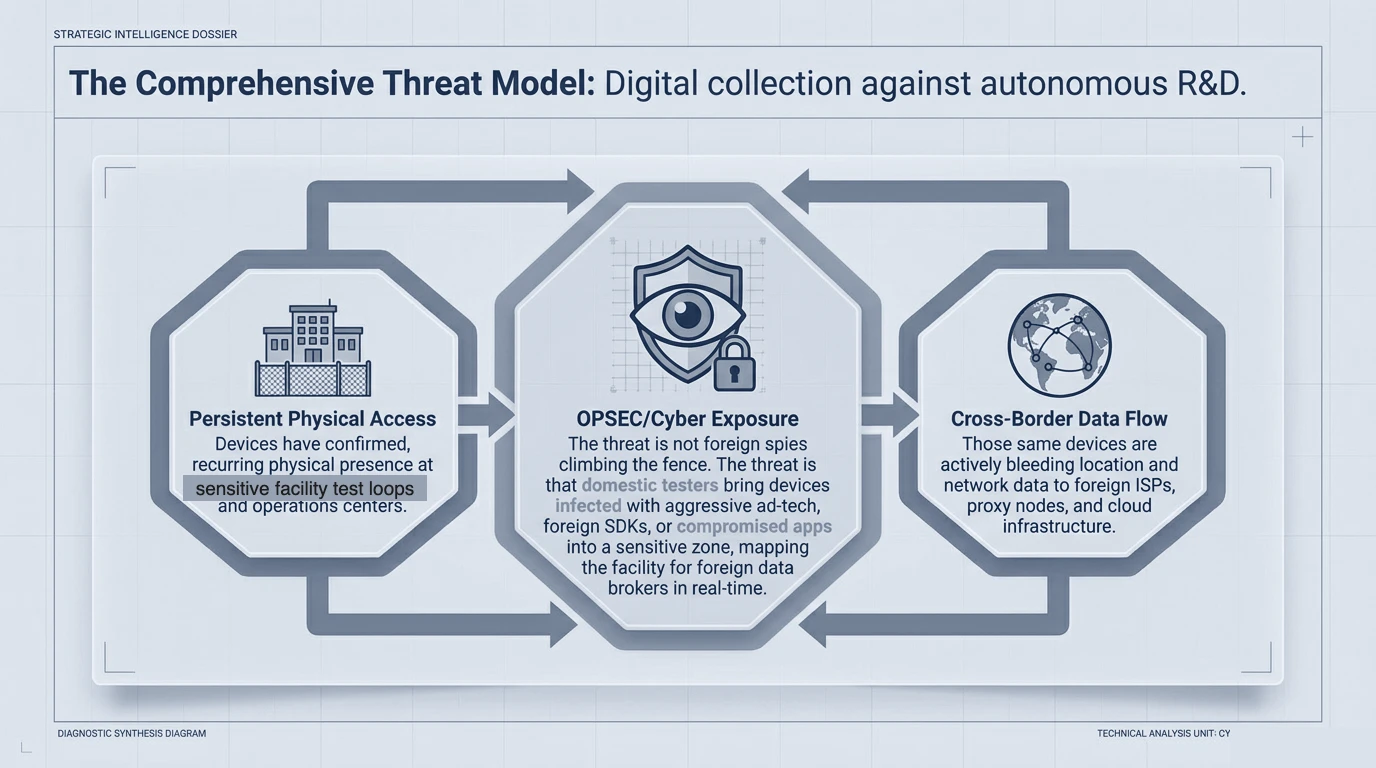
A three-part threat model: persistent physical access, OPSEC/cyber exposure, and cross-border data flow, connected in a cycle.
The comprehensive threat model. Persistent physical access, OPSEC/cyber exposure from trusted devices, and cross-border data flow form a single, self-reinforcing exposure.
Funnel
Thousands of devices reduced to a resident shortlist
Spoofing
Foreign-routed telemetry separated from real movement
Non-attributive
Prioritized for lawful technical validation
Note on sourcing. This case study is drawn from an analytical engagement at a sensitive testing facility. The facility, specific foreign geographies, device identifiers, and carriers have been removed or generalized; figures are illustrative of the analytical method. Reproduced visuals have had identifying names redacted.

Find what your telemetry is giving away.

Aurora™ is available to authorized government and security organizations. Access begins with a defined mission problem.