Platform Products Aurora™ askAurora™ Aurora:GeoStudio® Capabilities Use Cases Governance C3.ai Request Access

Use Case · Enterprise Site Security

Perimeter intelligence beyond the fence line.

Autonomous robotics, analyst triage, and licensed response secure everything that happens on the property. Aurora™ resolves what happens beyond it — turning reactive on-site security into predictive regional intelligence, lawfully.

Sector: Enterprise & Critical-Site Security Partner: Physical-security & autonomous-robotics provider Classification: Unclassified / Illustrative
The Challenge

Flawless on the property. Blind beyond it.

A modern site-security stack executes well: robotics patrol, analysts triage instantly, and licensed teams respond effectively. But every one of those capabilities only knows what happens inside the fence line. When a suspect vanishes, or an unseen threat gathers off-site, enterprise customers are blind to the historical context — who was routinely around the scene before the incident, and where they likely live or work.
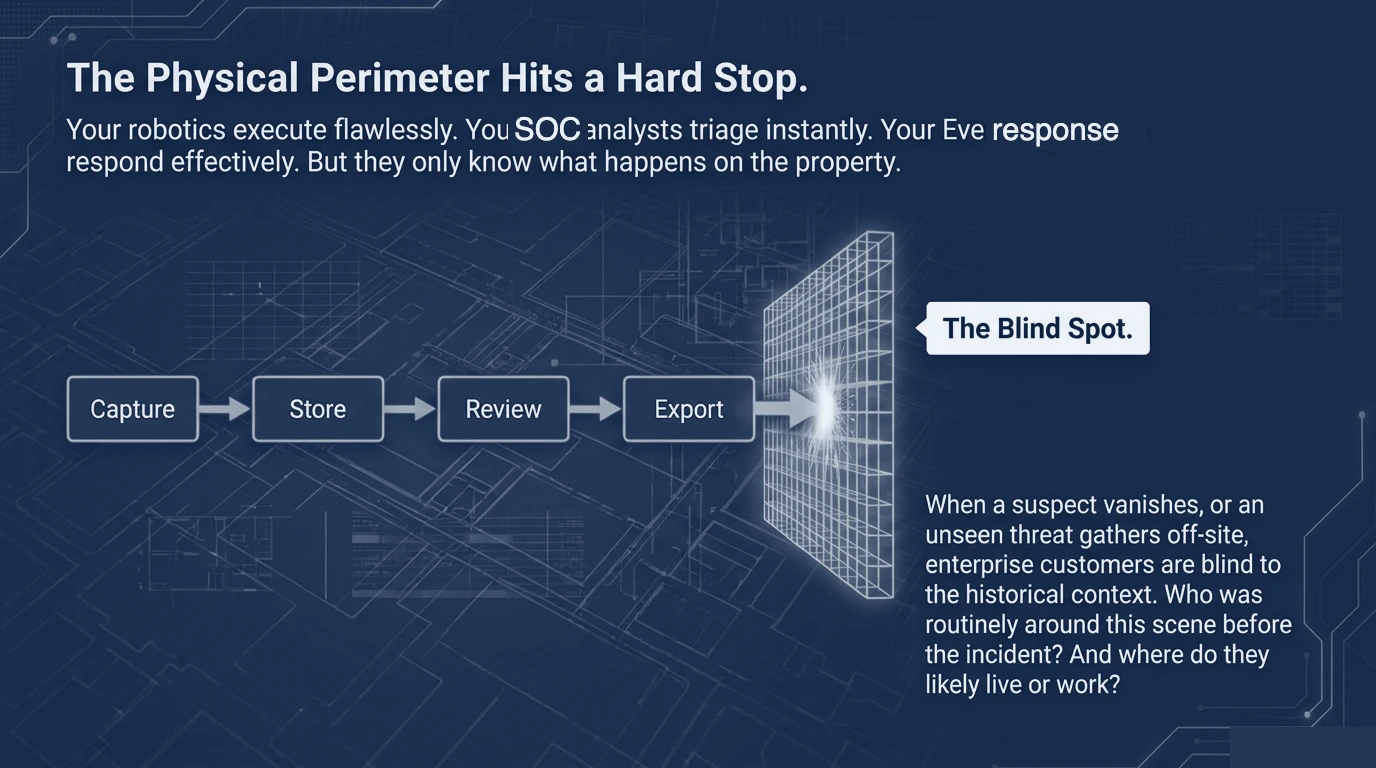
Capture, store, review, and export pipeline terminating at a glowing wall labelled The Blind Spot — illustrating how on-site security cannot see off-site context.
The blind spot. Capture → store → review → export ends at the property line. The pattern of who staged the threat — and where they came from — sits on the other side of the wall.
The Approach

External pattern-of-movement, generated as leads.

An OEM integration embeds Aurora:GeoCanvass® directly into the security platform. Given a location and a historical time window around an incident, it generates prioritized investigative leads even when no suspect is known — identifying recurring device clusters present near the site over time and surfacing the small set that merits focused review.
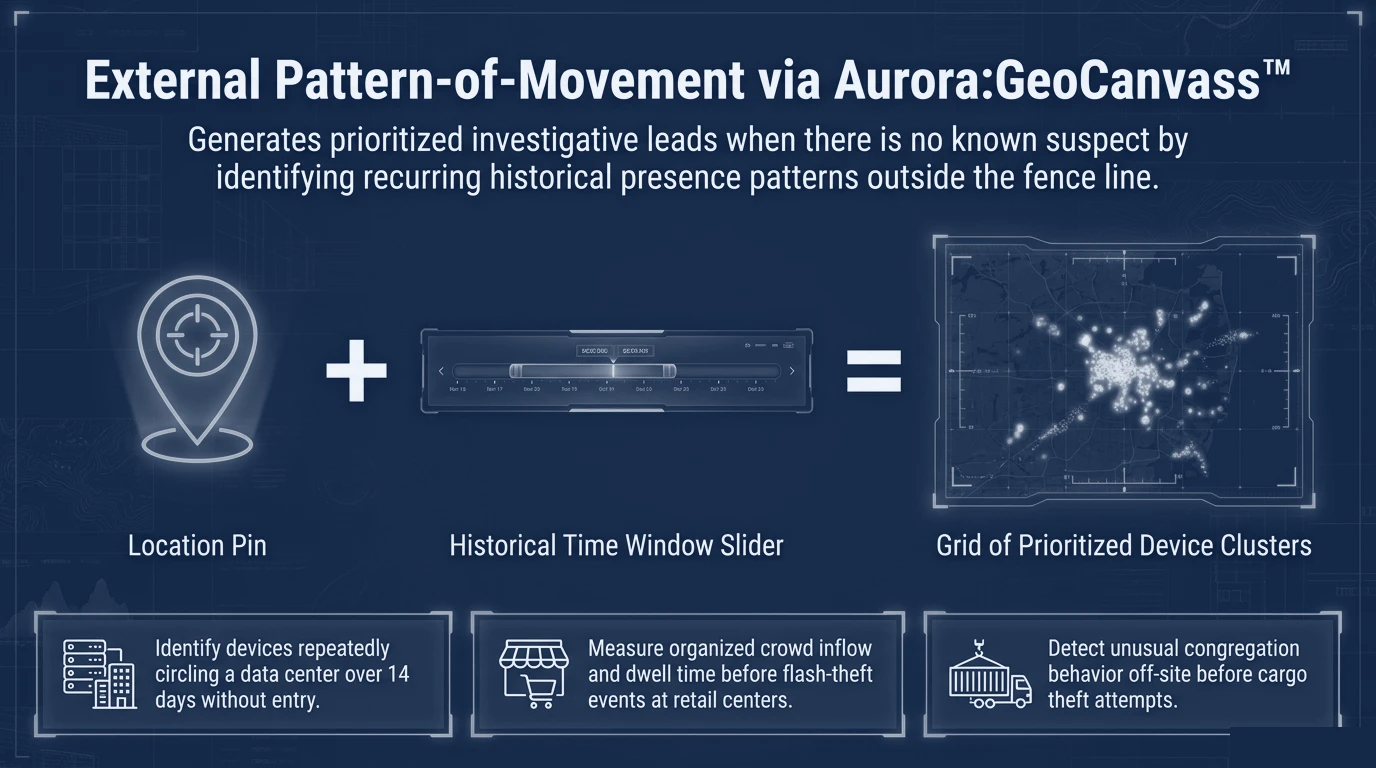
Aurora:GeoCanvass funnel: a location pin combined with a historical time-window slider resolves to a grid of prioritized device clusters.
Location + time window → prioritized clusters. Aurora:GeoCanvass® converts an area of interest and a look-back period into a ranked grid of device clusters — leads where there was previously no suspect.
The Outcome

From a single alert to a regional picture.

Aurora:GeoRunDown® converts raw historical movement into structured, executive-ready intelligence — resolving a device of interest back to likely bed-down and work locations and the broader regional targeting pattern. Reactive security becomes anticipatory: directors receive pattern-of-life briefings in minutes, with lead generation kept strictly separate from evidentiary use.
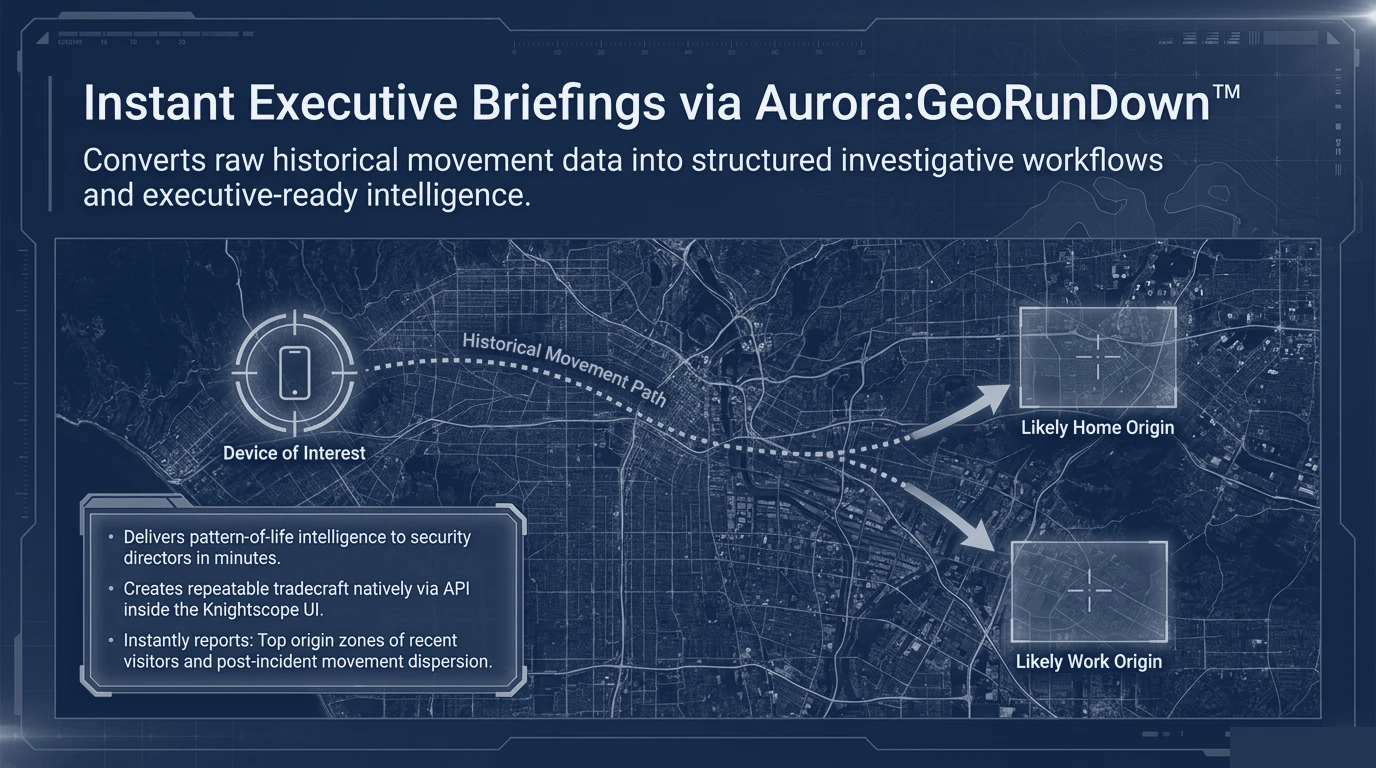
Aurora:GeoRunDown map resolving an area of interest to a likely bed-down origin and a likely work origin across a region.
Area of interest → likely origins. Aurora:GeoRunDown® traces movement from the incident scene to probable home and work locations for lawful follow-up by the appropriate authority.
Off-site
Intelligence extended beyond the property line
Minutes
From incident to regional pattern-of-life brief
Lawful
Lead generation kept separate from evidentiary use

Engineered for legal and privacy alignment.

The integration is built for highly regulated, enterprise environments. Deployments are anonymized, lead generation is treated as distinct from evidence, and the architecture is structured to keep investigative use within lawful bounds — aligned to the principles of Carpenter v. United States.
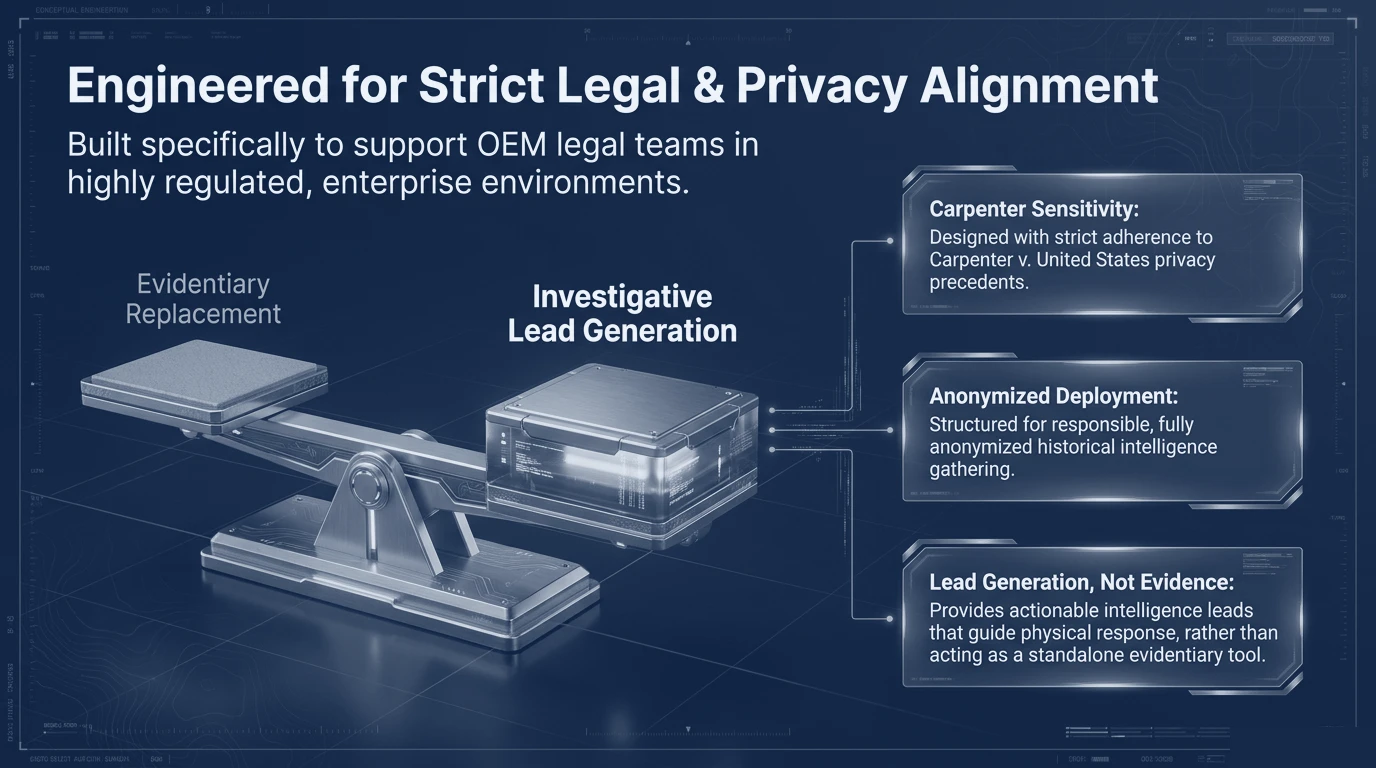
Three governance pillars: corporate sensitivity, anonymized deployment, and lead generation treated as distinct from evidence.
Lawful by design. Corporate sensitivity, anonymized deployment, and a firm separation between lead generation and evidence keep the capability defensible.
Note on sourcing. This case study is drawn from a partner engagement. Customer, partner, and individual identities have been removed and generalized; figures are illustrative of the analytical method, not a specific operation. Reproduced visuals have had partner names redacted.

Extend your perimeter beyond the fence line.

Aurora™ is available to authorized government and partner organizations. Access begins with a defined mission problem.